

Ground source heat pumps: horizontal collectors Vs. vertical boreholes

Doug Johnson
Ground source heat pumps: horizontal collectors Vs. vertical boreholes

In this post, we explain the benefits and key practical differences between the two most popular types of collector for ground source heat pumps.


Horizontal collectors or vertical boreholes?

Initial Disruption


Most of us understand that horizontal collectors require quite a bit of land to install; this is necessary to ensure correct spacing of collector pipes to maximise their efficiency. The pipes are often installed approximately 1.5m below ground level; usually in trenches spaced equally apart. To really maximise efficiency and safety, a large bulk excavation is undertaken and the pipe laid out like underfloor heating, ensuring an even distribution of heat is extracted. This kind of excavation requires big machines, time and space.


Many people are not aware that the collector area, once installed, will no longer be available for future tree planting, pond construction, driveways or any other construction as it has to be left porous and free from potential root damage. This can limit its application.


Boreholes too require a bit of mess at the start, and there is initial disruption with the physical installation i.e. drilling rig and other plant. However, when installed, the boreholes can be positioned under buildings, drives etc. and will take up far less space than horizontal collectors. Boreholes are often only 6” in diameter and have a small inspection chamber at the top of the hole. 

Diagram of a house on horizontal land and vertical poles, labeled Horizontal Terrain and Vertical Terrain.

Local Geology


Geology and ground conditions must be considered for both types of collector. Generally, the best areas for horizontal collectors are saturated or wetter areas of the site; to give the best long-term heat recovery and ensure lasting efficiency for years to come. Saturation is key to the horizontal collectors performing at their best. In our experience, the temperature within the collectors buried at 1.5m would fluctuate between 8ºC (cold winter) 14ºC (hot summer) at 1.5m depth, depending on seasonal fluctuations. As you go deeper into the ground, the temperature of the ground becomes much more stable and this is where boreholes come into their own.


Depending on the geology found on site, the temperature at 100m deep would remain at approximately 12ºC all year round, unaffected by seasonal changes. At these depths, the collector is well into the permanent water table level and would remain saturated all year round increasing conductivity too.


System Lifespan


Regarding the physical installation, i.e. pipework, provided that the correct materials are used for the installation and fusion welded, both ground loop and borehole systems should have a similar expected lifespan. It is anticipated that both systems would be in excess of 50 years, theoretically longer as there should be very little degradation to the plastics used as they are not exposed to sunlight.  Both systems would require the glycol (heat transfer fluid) to be changed periodically.


It is imperative that there are no mechanical connections underground which cannot be mapped and ultimately be reached if necessary. Best practice would minimise joints in the system as far as is possible.


The collector system should always be checked annually when the heat pump is serviced to ensure that all of the collector loops are working correctly.


Money, Money, Money


A true cost comparison should be made between the systems after full design. However, horizontal collectors are typically cheaper than boreholes as specialist drilling equipment is not required.  This can vary between a 0% – 30% reduction in cost depending on some of the following factors.


  • Poor local geology: requiring a larger collector field than normal
  • Protection for the horizontal collector against sharp stones or other underground features
  • Time spent excavating the trenches
  • Landscaping: levelling, reseeding and revisiting this after the trenches have settled
  • For horizontal collectors, ground reinstatement could be considerable depending on the finished specification for landscaping


Generally, for a single vertical borehole, costs are around £10,000 (due to high initial equipment mobilisation costs) but for multiple boreholes that cost can drop to nearer £6,000 per borehole.


If you dig trenches to put horizontal collectors in, costs work out to be around half that of doing a bulk excavation, so it is important to understand your overall strategy to nail down the project costs and stay within budget!

Home energy efficiency illustration with a white house outline and colorful A-to-G rating stairs in grass

System Efficiency


Even in a perfectly designed ground collector system, their relative proximity to the surface means that there is potential for seasonal changes in ground temperature, and slightly increased heat pump inefficiency during winter.  And the same effect can happen in summer if you are cooling a building; when using the warm ground to cool water to be used in the building for active cooling.


Boreholes conversely benefit from far greater depths and the water table and are not affected by the same fluctuations that horizontal loops are. As a result, it enables your heat pump system in a cold winter to be running at the same efficiency as in warmer weather.  When cooling, this is particularly beneficial and, as a result, boreholes are often used in office complex installations because of this superior cooling property.


Each collector type has its pros and cons. The best solution for your build will depend on cost, local geology, and bespoke technical requirements. Either way, you will be pleased to hear that the expertise for design and installation in this complex area is close at hand.


If you still have any questions about ground source heat pumps, or anything else to do with your low-energy home,
please don't hesitate to
contact the Mesh team today.

SHARE THIS POST WITH YOUR NETWORK

22 June 2026
Mesh Founding Director Doug Johnson has been invited to join the judging panel for this year’s Building Innovation Awards. These awards are a fantastic opportunity to showcase the incredible industry pioneers, innovations and technical advancements in UK construction. Together with a panel of influential clients and Tier 1 decision makers from across the construction sector, he will be evaluating the entries ahead of the awards celebration in Birmingham on 29th September 2026. The Building Innovation Awards the only awards scheme in the built environment sector to be recognised with the prestigious Outstanding Awards Trust Mark from the Independent Awards Standards Council (IASC). Doug Johnson: "It is an immense privilege to join such as esteemed panel of clients and industry professionals. We have so much to be proud of in the built environment and these awards are a brilliant opportunity to celebrate innovation which keeps our sector advancing, particularly in the areas of sustainable development and construction as we work towards net zero and the vital need to accelerate decarbonisation. Innovation is absolutely central to that." More details about the awards here .
15 June 2026
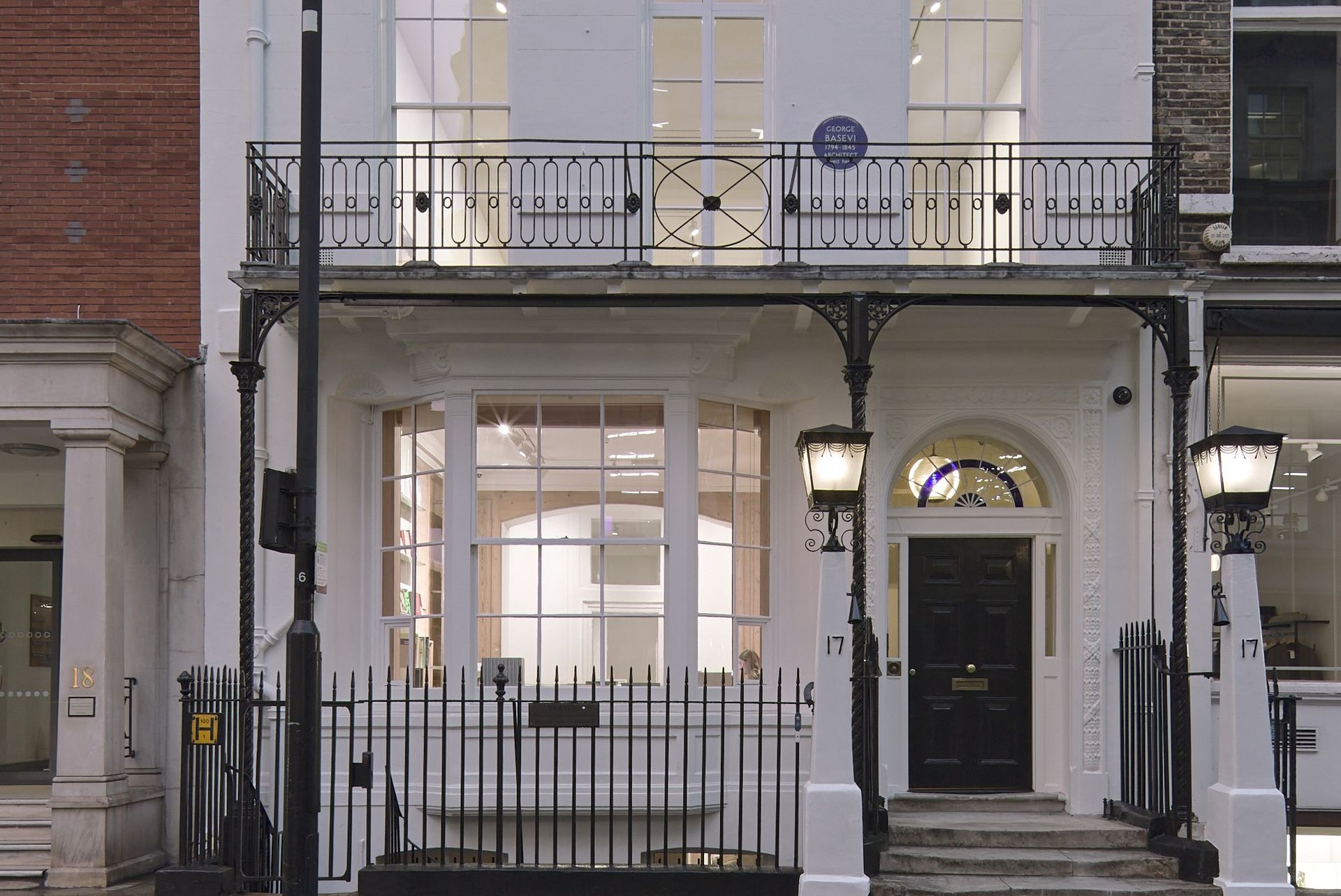
Building performance specialist Mesh has completed a building services design project for a new flagship art gallery in Savile Row – Sadie Coles HQ. The six-storey Grade II listed Georgian townhouse in London’s Mayfair, which dates back to the 1730s, has been fully restored and transformed by lead contractor Work Ltd, to create a unique space for contemporary art. The building, once home to the Burlington Fine Arts Club in the 19th century, had been bomb damaged in World War II and used as offices post-war. It has now been sensitively reinstated as a space for artists to exhibit their work in a part of London which has a long association with contemporary art. The key aim of this extensive refurbishment project was to work to a fast-track programme for the gallery’s opening to coincide with the Frieze Art Fair. Mesh was appointed to develop a holistic MEP building services strategy, from concept through to detailed design, and in keeping with the character and constraints of this heritage building. Enhanced control of the internal environment was required to maintain visitor comfort all year round and in the context of continually fluctuating occupancy levels, including events for up to 200 people. Working within a Grade II listed building required a highly considered approach at every stage – historic architectural features were revealed and restored internally and externally, and extensive structural improvements were required to accommodate art loadings. These factors had to be reflected in the services design and specification. Mesh used dynamic thermal modelling for different scenarios of use to understand the heating and cooling loads required and to allow the services to be accurately sized for each room or gallery. Two priorities were cooling and for each area to be individually controlled according to occupancy levels. Discrete but robust heating and cooling provision was designed for the gallery areas and the MEP services were concealed in void spaces to avoid impacting on the architectural features of the building or the layout of the galleries. Plant and equipment had to be sited in compliance with stringent planning requirements, which limited the number, size, position and visual impact of the external units. Passive measures were introduced to reduce energy consumption and included actuated openable rooflights in a glazed lantern to purge warm air during the day and reduce the reliance on the active cooling system. Giles Reid, Giles Reid Architects: “The new gallery has succeeded in its ambition – to reaffirm that London has an important position in the global art world. This was a complex project which had to be delivered in just nine months from planning approval for the fixed deadline for opening, and despite having to carry out extensive structural alterations. The building is performing well from a services perspective, including at the opening event which was attended by around 800 guests. The M&E design in contemporary art spaces like this must never detract, visually or acoustically, from the art being exhibited and this has been successfully achieved. This is a fantastic statement building which has been acclaimed and the Client is thrilled. It is a credit to everyone involved that this historic building has been brought back into use for contemporary art.” Doug Johnson, Founding Director of Mesh: “This project demonstrates exactly what intelligent building services engineering should deliver – an integrated, high-performance solution to deliver year-round-comfort for visitors and users of the building whilst maintaining a clean aesthetic. Working within a Grade II listed building with complex planning restrictions required genuinely creative engineering rather than a conventional response. We are really proud to have contributed to this outstanding building transformation.” The Project Team: Client: Sadie Coles HQ Lead contractor (design and delivery): Work Ltd Architectural partner: Giles Reid Architects MEP design / building performance: Mesh About Mesh Mesh offers a range of design and engineering services to help organisations in the public and private sectors to improve the energy efficiency of new and existing buildings, housing and estates. This includes support for architects; planning; thermal modelling and overheating analyses; carbon reduction strategies; feasibility studies for renewable technologies; MEP design, and regulatory compliance. Architectural images - Joseph Asghar
Building performance specialists Mesh names in the Sunday Times Best Places to Work List 2026
1 June 2026
Building performance specialists Mesh names in the Sunday Times Best Places to Work List 2026
Four people posing at an awards event, one holding a framed certificate, in front of a logo backdrop
20 May 2026
Mesh Energy wins Energy Efficiency Consultancy of the Year for innovative low-carbon solutions. Contact us for expert energy strategies.
Indoor botanical garden with arched glass roof and elevated walkways over lush greenery
by Doug Johnson 1 May 2026
Explore battery storage tech for sustainable building design. Improve energy efficiency & manage costs effectively. Contact us today!
Scattered wooden letter tiles spelling words on a tabletop, with several tiles stacked and overlapping.
by Rhiannon James 1 May 2026
Understand renewable energy acronyms for sustainable design. Contact us for feasibility studies to enhance your project.
Interview title slide: “Delivering Success for Paragraph 84” with portrait of Rob Hughes on dark background
7 April 2026
Rob Hughes discusses navigating Paragraph 84 for rural planning success. Contact us for expert advice on sustainable building design.
Bright wooden restaurant interior with tables, chairs, plants, and large windows letting in natural light
9 March 2026
Mesh enhances energy efficiency & sustainability at Westonbirt Arboretum. Contact us to learn about our eco-friendly solutions.
Modern apartment buildings with balconies beside a grassy courtyard and walkway under a blue sky
by Doug Johnson 25 February 2026
Explore the link between fuel poverty, health, & overheating in housing. Contact us for sustainable building solutions.
Promotional slide for New Embodied Carbon Calculator V9
by Doug Johnson 3 February 2026
Use Mesh's new calculator for quick, accurate carbon assessments. Compare designs & meet RIBA 2030 targets efficiently.

Subsribe to memo from mesh