

RIBA Plan of Work 

Stage 0-3 Support

Workflow diagram:

The opportunity to make key sustainable and beneficial decisions at the early stages of concept design are often overlooked. Mesh recommends that this is where you and your client should start the conversation.

Clients often hold off spending money on consultancy fees until after planning. The problem with this is that as the design phases progress, options and design choices reduce and costs increase rapidly. At worst, lack of sustainable design considerations before going for planning permission can lead to a resubmission or, indeed, fundamental building design elements that are not compatible to reach the desired energy efficiency goals of the client.


Mesh can help you and your client to navigate this early-stage design. We help to keep costs under control, whilst also giving appropriate design analysis and consideration before submitting the building for approval.

For the most successful low-energy and progressive projects, we find the following services offer benefits to both the homeowner and wider design team:

Initial overheating analysis

gives peace of mind that the building design is within comfortable limits and is thermally stable year round. Any issues can be flagged and the design modified appropriately without compromising the aesthetics. 

Building fabric optimisation

allows you to intelligently spend the project budget precisely where it will have the biggest impact on energy bill savings and thermal comfort. Ideal if you have a fixed budget for insulation work or an optimal design point you are trying to uncover.

Renewable energy feasibility

enables you to holistically review renewable technology options for the building, understand capital and running costs, available government subsidies and the best way to proceed. The optimised whole-site strategy will give your design team clarity for moving the project into the next stage. 

Embodied Carbon Analysis

can be supported at the very earliest stages of your project for even concept designs to better inform design evolution. Be sure you’re on the right track and designing progressive and beautiful, lower carbon buildings with confidence. 

Vertical gradient, white to light gray.

By taking a measured approach at this early stage, we take the guesswork out of low-energy building design. 

Embodied Carbon Calculator

Our FREE Embodied Carbon Calculator gives a valuable insight at the very early stages of the design process allowing you to discover how the embodied carbon of your designs is affected by material choice and also how your building compares to the RIBA 2030 targets.
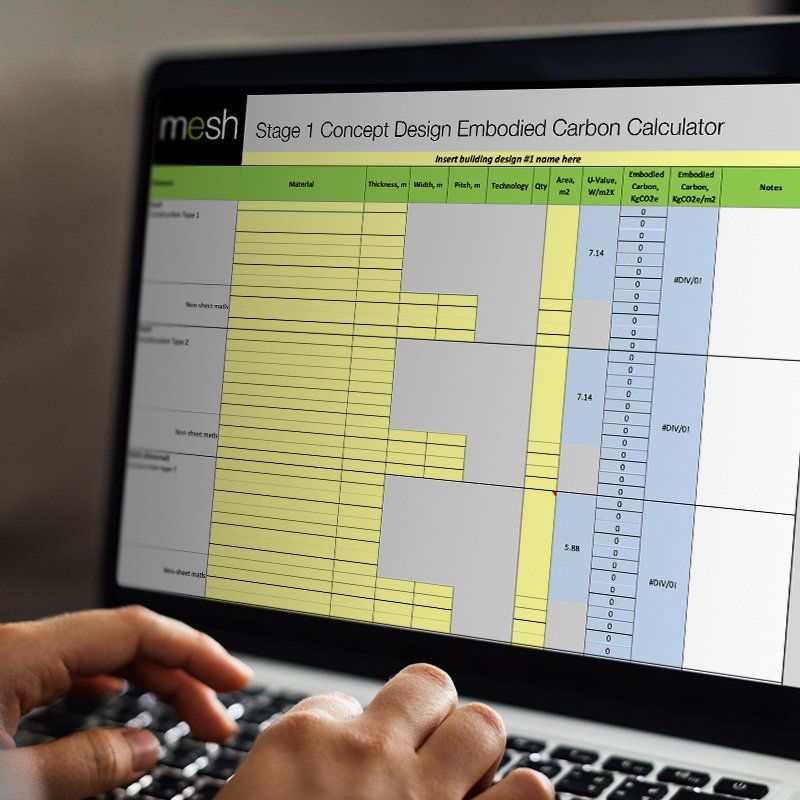
LEARN MORE ABOUT THE EC CALCULATOR
Embodied carbon calculator

At whichever stage of your project you are, drop us a line and we will be glad to support you


Relevant Articles

9 March 2026
Energy performance specialist Mesh has successfully delivered a sustainability project for Forestry England at Westonbirt, The National Arboretum, helping to improve the energy efficiency and long-term resilience of buildings on the 600-acre estate. The historic arboretum near Tetbury, managed by Forestry England, is one of the UK’s most visited heritage sites, attracting hundreds of thousands of visitors every year. Rapid growth in visitor numbers, combined with the impact of climate change, prompted the need for a clear, practical plan to reduce energy use and carbon emissions across the estate’s facilities including the visitor centre, café and restaurant and offices. Following a competitive tender, Mesh was appointed to develop an evidence-based strategy to guide building upgrades, balancing sustainability ambitions and the transition away from fossil fuels in this sensitive rural and heritage setting. Mesh took a whole-building approach, assessing how the buildings on the estate currently perform, how they are used at different times of the year in line with fluctuating seasonal visitor patterns, and how future changes to climatic conditions could affect running costs and user comfort. This has enabled Forestry England to make informed decisions on heating solutions, energy supply and building fabric improvements, and to plan upgrades in a phased approach. It provides a clear framework for improving energy efficiency, and importantly, for moving away from fossil fuels. Several of the strategies have already been implemented, delivering immediate energy efficiency improvements whilst informing longer-term refurbishment and upgrading plans. Sophie Nash, Programme Manager at Forestry England: “Our aim with this project was to use detailed analysis to steer our specifications for remediation and upgrading works to improve the energy efficiency and sustainability of our most heavily-used buildings at Westonbirt and the resilience of our electricity infrastructure to support future growth. The assessments carried out which were very thorough and detailed, provide us with valuable insight to inform the design and specification of refurbishment and remediation works in a phased approach.” Doug Johnson, Founder and Director of Mesh: “For rural estates, landowners, parks and visitor attractions across the UK, this project for Forestry England clearly demonstrates how a data-led, whole-building approach can accelerate decarbonisation and create a clear route towards net zero – even in the most sensitive heritage environments and landscapes.” The Westonbirt project reflects growing demand from rural estates, landowners and visitor attractions for clear sustainability strategies that reduce risk, improve performance and support long-term resilience. Image credit - Forestry England / Brian Martin
by Doug Johnson 25 February 2026
The direction of travel for affordable housing is clear. Legislation and policy, including Awaab’s Law and the recently announced Warm Homes Plan, are rightly focused on improving the quality, safety and energy efficiency of affordable homes, whilst tackling fuel poverty and the cost-of-living crisis. Warmer homes should reduce energy bills, improve occupier comfort, support better health outcomes and contribute significantly towards the drive to net zero. However, whilst this ambition is welcome and needed, there is an emerging contradiction – the very measures designed to make homes warmer, more airtight and cheaper to run can also significantly increase the risk of overheating. As climate change brings more frequent and intense heatwaves, overheating is no longer a marginal issue. It is becoming a clear housing risk and even more so for the more vulnerable members of our society. The Warm Homes Plan is fundamentally about enabling people to live affordably in their homes, using modern and renewable technologies to reduce energy consumption and carbon emissions at a time when fuel poverty is rising. That principle is sound. Equally, well-ventilated homes are directly linked to good health and wellbeing. Overheating has a measurable impact on physical and mental health, including sleep quality, metabolic health and productivity. An occupant-centred approach therefore has to underpin the Warm Homes Plan, balancing affordability with health outcomes. The policy’s recognition that passive or active cooling may be required to mitigate overheating is an important acknowledgement that energy efficiency alone is not enough – but it is a complex challenge to address. Why overheating matters – and why it is complex The risk of overheating is surprisingly acute in well-performing homes. Highly insulated, airtight homes – including those built to high specifications and Passivhaus principles – can be vulnerable to excessive internal temperatures if ventilation and heat removal are not carefully designed in at the outset. For residents in affordable housing – including older people and those requiring specialist care – getting this balance wrong has serious consequences. The response to the Warm Homes Plan therefore needs to be right first time, with health and wellbeing underpinned by the appropriate level of technical expertise and correct and ideally regulated execution. The Cooling Hierarchy Well-insulated buildings make absolute sense, but insulation, airtightness and ventilation must be addressed as part of a cohesive energy strategy. Comfort cooling is a more practical solution for reducing temperature. Air conditioning also manages humidity but is energy intensive, maintenance-heavy and costly to run, even when paired with solar. However, there is significant untapped potential in passive measures such as external shading, blinds and shutters – commonplace in warmer climates but still under-utilised in the UK. This is the cooling ‘hierarchy’: 1. Minimise internal heat generation through energy efficient design 2. Reduce the amount of heat entering the home in summer through orientation, shading, fenestration, insulation and green roofs and walls 3. Manage heat within a building through thermal zoning, buffer spaces, exposed internal thermal mass and higher ceilings 4. Passive ventilation 5. Mechanical ventilation 6. Active cooling systems such as air conditioning. The Need for a More Holistic Approach Overheating cannot be considered in isolation. Whole-life carbon, operational emissions from heating systems, materials selection, and long-term maintenance and repair all need to be addressed as part of the transition away from fossil fuels and towards more energy-efficient homes. Ventilation may be key to passive cooling, but real-world constraints quickly emerge. The external acoustic environment matters – homes adjacent to busy roads or railway lines may not be able to rely on opening windows for ventilation without compromising wellbeing. In dense urban areas, background noise can itself become a health issue. Regulatory requirements will also shape the solution. The Building Safety Act requires consideration around fall protection, which may limit window openings through restrictors. Air pollution is another constraint, particularly in city centres. The layout of multi-occupancy housing can severely limit natural cooling strategies. Traditional apartment layouts – with homes on either side of a corridor – make cross-ventilation for cooling extremely difficult, regardless of insulation levels. These inter-relating factors vary widely depending on location, building age and housing typology. Improving thermal performance through additional insulation also introduces the risk of interstitial condensation if ventilation levels are not properly understood. There is no silver bullet or single solution. Designing Building Performance Strategies that Work in Practice The starting point is to treat each building as a whole, rather than a suite of measures to be installed. No single element should be changed without first clarity on how it affects the whole property and its occupants. This requires time, analysis and robust thermal modelling, enabling housing providers to understand, at a systems level, what interventions will deliver the greatest benefit without creating new risks and health hazards such as condensation or overheating. Technology is rapidly advancing. The first ventilation systems with integrated cooling are now available and can be combined with building fabric upgrades and low-energy renewable heating. Where roof orientation allows, solar energy can help offset the additional electrical demand of these cooling systems. But technology alone is not the answer. Occupant profiling is critical. Homes occupied by older or more vulnerable residents, who are likely to remain in the property during the day, need to perform very differently from those properties occupied mainly in the evenings. Overheating in daytime is harder to mitigate than night overheating, and these factors need to inform the performance strategies from the outset. There are significant risks to undertaking blanket upgrades to heating, glazing and insulation without detailed analysis. Homes can take many hours to cool once overheated, and what appears to be a sensible energy upgrade in theory may be hugely detrimental to resident health and wellbeing, increasing risk of non-compliance under Awaab’s Law. There is a delicate balance between resident comfort, health, running costs and carbon emissions, and it cannot be achieved without detailed analysis, modelling and complex calculations. New build affordable homes have more flexibility – window orientation, shading and layout can all be optimised. Retrofit is more challenging. Orientation of roofs or windows cannot be changed; internal insulation reduces room sizes, and the existing interior is someone’s home. The solution will differ from building to building, even across similar typologies. The key is to design for residents – present and future – rather than relying on standardised assumptions. The new legislation rightly raises expectations around building safety, health and affordability, but overheating must be treated as a core risk, not an afterthought. Without a holistic, evidence-led approach, these well-intentioned policies risk poor outcomes for the very people they are designed to help. However, this is also a huge opportunity to increase the affordability, health and resilience of social housing in a changing climate.